China-Portugal Joint Research Institute Officially Launched in Lisbon with Key International Collaboration
On October 11th, In a significant step forward for Sino-Portuguese relations, the China-Portugal Joint Research Institute of Climate and Energy was formally inaugurated today at the Instituto Superior Técnico, Lisbon. The signing and plaque unveiling ceremony, held in the presence of the Chinese Ambassador to Portugal, Zhao Bentang, marks the beginning of a new era of cooperation between two prestigious academic institutions.
The memorandum to establish the institute was signed by Rogério Colaço, President of the Instituto Superior Técnico, and Bao Zhidong, Vice President of China University of Petroleum-Beijing, a leading institution in China's energy sector. The creation of this joint research institute reflects the shared commitment of both nations to address the pressing global challenges of climate change and energy transition.
In his address, Rogério Colaço congratulated both universities on this landmark achievement, highlighting the potential of young scholars from both countries. "The future of our cooperation lies in the hands of our rising academics, and through them, we build lasting bridges between Portugal and China," he remarked, with an optimistic view toward future collaboration in climate and energy studies.
Bao Zhidong, reflecting on the broader context of Sino-Portuguese relations, pointed out that this year marks the 45th anniversary of diplomatic relations between the two countries. “In this age of global climate challenges, collaboration in artificial intelligence and climate energy is not only timely but of profound strategic importance,” he said. He described the establishment of the joint institute as a new milestone, one that builds on decades of educational and scientific partnerships between China and Portugal.
Ambassador Zhao Bentang echoed these sentiments, emphasizing the priority both the Chinese and Portuguese governments place on research in climate and energy. In a speech that resonated with the theme of deep-rooted friendship, he referred to the 500-year history of Sino-Portuguese relations and expressed hope that this partnership would herald a new chapter in their shared legacy. "The collaboration between young scientists from both nations will not only enhance our traditional friendship but also contribute to the world’s transition towards green, low-carbon, and sustainable development," Zhao noted.
Professors Liao Zonghu from China and Leonardo Azevedo from Portugal were singled out as pivotal figures in the founding of the institute. Their efforts, Ambassador Zhao said, symbolize the future of Sino-Portuguese scientific cooperation and the hope for even greater achievements in the fields of climate and energy.
The event underscores the growing importance of international academic partnerships as both China and Portugal seek to strengthen their positions in the global dialogue on climate change, energy innovation, and sustainable development.
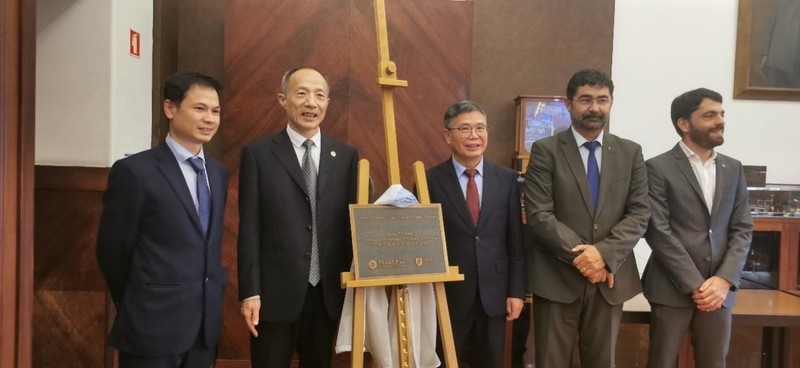
Figure : Ceremony of the China-Portugal Joint Research Institute of Climate and Energy. From left to right: Liao Zonghu, Bao Zhidong, Zhao Bentang, Rogério Colaço, Leonardo Azevedo.
The memorandum to establish the institute was signed by Rogério Colaço, President of the Instituto Superior Técnico, and Bao Zhidong, Vice President of China University of Petroleum-Beijing, a leading institution in China's energy sector. The creation of this joint research institute reflects the shared commitment of both nations to address the pressing global challenges of climate change and energy transition.
In his address, Rogério Colaço congratulated both universities on this landmark achievement, highlighting the potential of young scholars from both countries. "The future of our cooperation lies in the hands of our rising academics, and through them, we build lasting bridges between Portugal and China," he remarked, with an optimistic view toward future collaboration in climate and energy studies.
Bao Zhidong, reflecting on the broader context of Sino-Portuguese relations, pointed out that this year marks the 45th anniversary of diplomatic relations between the two countries. “In this age of global climate challenges, collaboration in artificial intelligence and climate energy is not only timely but of profound strategic importance,” he said. He described the establishment of the joint institute as a new milestone, one that builds on decades of educational and scientific partnerships between China and Portugal.
Ambassador Zhao Bentang echoed these sentiments, emphasizing the priority both the Chinese and Portuguese governments place on research in climate and energy. In a speech that resonated with the theme of deep-rooted friendship, he referred to the 500-year history of Sino-Portuguese relations and expressed hope that this partnership would herald a new chapter in their shared legacy. "The collaboration between young scientists from both nations will not only enhance our traditional friendship but also contribute to the world’s transition towards green, low-carbon, and sustainable development," Zhao noted.
Professors Liao Zonghu from China and Leonardo Azevedo from Portugal were singled out as pivotal figures in the founding of the institute. Their efforts, Ambassador Zhao said, symbolize the future of Sino-Portuguese scientific cooperation and the hope for even greater achievements in the fields of climate and energy.
The event underscores the growing importance of international academic partnerships as both China and Portugal seek to strengthen their positions in the global dialogue on climate change, energy innovation, and sustainable development.
Figure : Ceremony of the China-Portugal Joint Research Institute of Climate and Energy. From left to right: Liao Zonghu, Bao Zhidong, Zhao Bentang, Rogério Colaço, Leonardo Azevedo.
Comments
Post a Comment